
Tintin in America by Hergé
Tintin in America by Hergé – Tintin #3 – is the second comic book I read in the series. I missed the second one – in Congo. I think is a mistake to consider these as children’s book, something that happens with many other books – like Animal Farm or Black Beauty. It might be a comic, but it has some rather strong political or social messages.
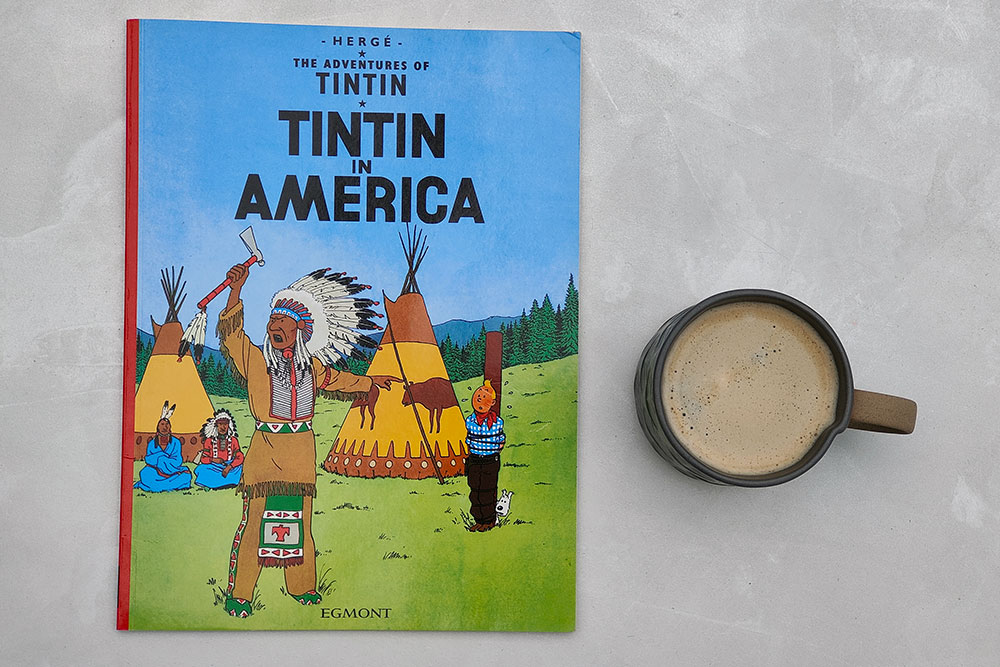
Tintin and Snowy are in Chicago. He is fighting gangsters and outsmarts all but one, who gets away. Tintin is pursuing him and ends up in the Wild West, where he meets Native Americans. I think that part of the book is well made, for a topic that was and it is sensitive. I enjoyed this comic as well and I would like to read more, if I have the opportunity.
Tintin in America by Hergé
Details about the picture: –
My rating: 5/5 Stars
Would I recommend it: yes
Published by: Egmont UK
Year it was published: 2012 (first published in 1932)
Format: Paperback
Genre(s): Comic book
Pages: 62
About the author: Georges Prosper Remi (22 May 1907 – 3 March 1983), better known by the pen name Hergé, was a Belgian comics writer and artist.
His best known and most substantial work is The Adventures of Tintin comic book series, which he wrote and illustrated from 1929 until his death in 1983, leaving the twenty-fourth Tintin adventure Tintin and Alph-Art unfinished. His work remains a strong influence on comics, particularly in Europe.
“Hergé” is the pseudonym of George Remí, making a game with the initials of his name inverted. Throughout the evolution of his star character, Tintin, we can see the progress of this author: from the first titles marked by the ultraconservative doctrine of the director of the newspaper Le Petit Vingtième, to the breaking of conventions embodied from The Blue Lotus , as well as the evolution of the society of his time. The research carried out by Hergé to historically contextualize his Adventures, as well as his implicit social criticism, have made Tintin a masterpiece of the 20th century.
Website & Social Media Links: –
It’s an exciting cover (tied to the stake!). Did the book call them “Native Americans” or just Indians? I’m still inclined to say “American Indians” or sometimes “indigenous People”.
Kelly recently posted…A Stranger in a Strange Land by Robert A. Heinlein
In the book they are called Indians. The tied to the stake part is in the story. It’s a fun book.