
Invisible University for Ukraine by Ostap Sereda
Invisible University for Ukraine by Ostap Sereda is a collection of essays, based on their personal experience during the russia-Ukraine war.
The Invisible University for Ukraine (IUFU) is a certificate program, with ECTS credits, for undergraduate and graduate students from Ukraine, still in Ukraine or in refuge. The name of this transnational solidarity program is a nod to the various 19th and 20th underground and exile educational initiatives, for example the “flying universities” in Eastern Europe.
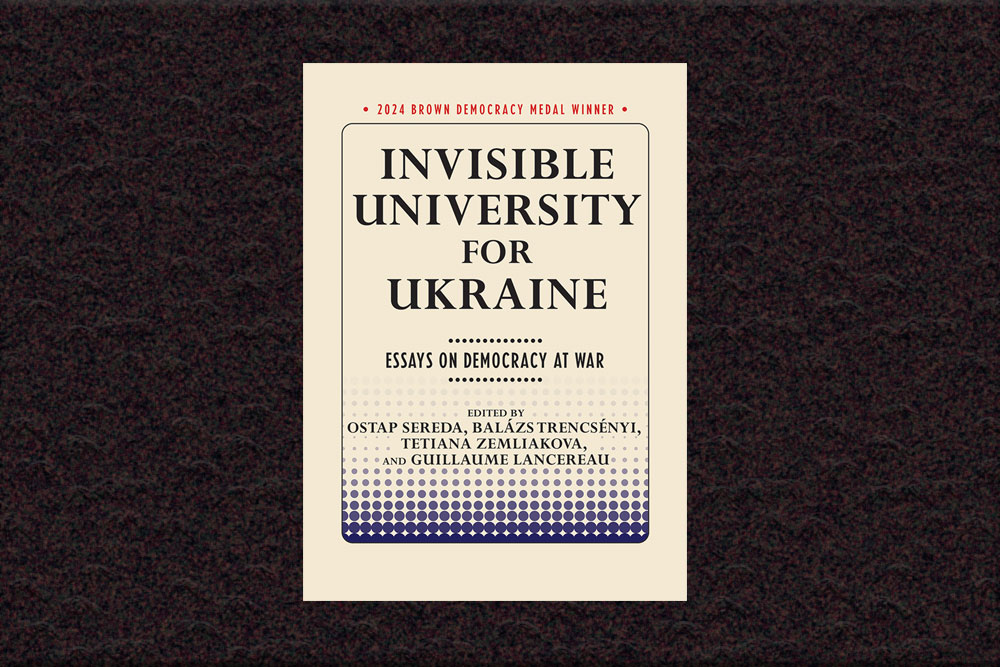
As it is the case with these collections, some essays are more interesting and relatable than others. I was even annoyed with a couple of the things mentioned there, but overall I enjoyed this book a lot. The book offers a very wide range of perspectives. I know one of the contributors and that was really nice.
I recommend reading this book, it’s not long and the essays are a few pages long, making it very easy to read. Despite being written by academics, the style is personal, these sound more like a letter or a discussion than an essay. It’s normal, as this is about their own experiences.
Invisible University for Ukraine by Ostap Sereda
Details about the picture: –
My rating: 4/5 Stars
Would I recommend it: yes
Published by: Cornell University Press
Year it was published: 2024
Format: e-book
Genre(s): Politics
Pages: 168
About the authors: Liana Blikharska, from Zhovkva, is writing her dissertation at the Ukrainian Catholic University and tries to understand how people create ideas and live with them. She considers the word “obvious” highly problematic and thinks that details in war can easily get lost in the shuffle.
Nadiia Chervinska, from Kolomyia, is a philosophy and history graduate who wants to believe that care, empathy, and support will one day become more powerful than military weapons.
Marta Haiduchok, from Lviv, is a PhD researcher in history at CEU. She wrote her text not because she wanted to but despite her wish never to do so. Marta’s mother agrees with her essay fully.
Sasha Kokhan, from Kharkiv and Kyiv, is now studying social anthropology in Vienna. She hopes that in a couple of years, her present predictions will seem incorrect and excessively pessimistic.
Sasha Korobeinikov, from Kikvidze, is a PhD candidate in history at CEU and is currently researching Russian colonialism, imperialism, and decolonization at Freie Universität Berlin. Although he maintains an overall optimistic outlook, he is skeptical about the prospects for global democratic development in the near future.
Ela Kwiecińska, from Warsaw, is a historian and social scientist who taught modern Ukrainian and Polish history at the Faculty of History, University of Warsaw, from 2022 to 2024. She has worked at IUFU since the beginning of April 2022. Ela keeps reflecting on the limits of solidarity and the position of a non-Ukrainian bystander.
Guillaume Lancereau, from Paris, studied history and sociology in Paris, Princeton, and Florence. Since 2022, he has not been sure how to answer the question, “What are you working on?” He is still struggling with the idea that humans would need war or death to understand things differently and undertake anything new.
Katia Lysenko has departed from and is eternally returning to Poltava, although now she studies philosophy in Leipzig. Katia believes there will be no “after” the war in her life. Katia tries to record the contemporaneity that is yet to come and holds on to the future that has come already.
Kateryna Osypchuk, from Kyiv, is a history major focused on the intersection of collective memory and urban studies. She reflects on how the war transformed the sense of belonging and how this, in turn, affects understanding and articulating the war. She wishes that a different cause would have strengthened these community bonds.
Oleksii Rudenko, from Mykolaiv, is a private first class of the Armed Forces of Ukraine and a PhD candidate in comparative history at the Central European University, currently on academic leave. In his first and probably last publication of 2024, Oleksii wants to evoke the classics: Ceterum censeo Moscoviam delendam esse.
Ostap Sereda, from Lviv, teaches modern history at the Ukrainian Catholic University, Central European University, and Bard College Berlin. He is also a coorganizer of IUFU. Heis concerned about the multiple long-lasting effects of the war.
Nataliia Shuliakova, from Odesa, studied history in Vienna. Currently, she lives between Kyiv and New Haven, pursuing her studies in memory politics and urban history. She believes that the hardest thing during the war is to preserve humanness and that love doesn’t die after people do.
Maksym Snihyr, from Kyiv, is a PhD researcher at Kyiv-Mohyla Academy, currently based in Regensburg. For a long time, Maksym considered himself an expat rather than part of the diaspora, but as the war drags on, he feels the increasing severance of his ties with home.
Olha Stasiuk, from Vinnytsia, is a PhD researcher in medieval studies at CEU and a cofounder of the Stasiuk Foundation that provides help to military hospitals and combat medics on the front line. For Olha, caring in this war means to remember that everyone might be in more pain than you; it means being aware of one’s responsibility for the historical period and that fighting is a choice.
Denys Tereshchenko, from Poltava, studied political science in Kyiv and history in Vienna and is now beginning his PhD program at the European University Institute, Florence. Since the first week of the full-scale invasion, Denys has believed this war will last forever.
Balázs Trencsényi, from Budapest, is a Professor at the History Department of CEU in Vienna, the director of CEU’s Institute for Advanced Study in Budapest, and a coorganizer of IUFU. He wishes we could have launched such an invisible university not as a response to the war but merely for intellectual pleasure.
Diána Vonnák, from Budapest, is a social anthropologist based in Scotland at the University of Stirling. She has worked in Ukraine since 2015. Initially, she wanted to understand how people cope with the heritage of past wars and collapsed political projects, but history caught up with her.
Yevhen Yashchuk, from Zhytomyr, studied history at five universities and spent his days helping at humanitarian centers and his nights coordinating students at IUFU before starting his PhD at Oxford. He observes the humanities’ reluctance to critically approach the war-affected world, the emergence of new possibilities at the price of death, and the growing demand for actions with little time to evaluate them.
Tetiana Zemliakova, from Poltava, studied political science and history in Kyiv, Cambridge, and Florence. After the invasion, she focused on the ontology of time and IUFU. She always knew she was living through the last days of historical humankind, but she could never guess these would be so stupid.
Website & Social Media Links: –
This was actually free on Kindle, so I went ahead and got it. I’m backed up on reading, but I’ll get to it eventually.
Kelly recently posted…The Lion King