
Cum s-a românizat România by Lucian Boia
Cum s-a românizat România by Lucian Boia – How Romania became Romanized by Lucian Boia – is another book I bought while in Romania. It is a short and fascinating book. I am not completely happy with the English translation of the title, as I feel it misses some nuances, but I can’t find a better one. It is about how the national sentiment was born and grew since mid-1850s.
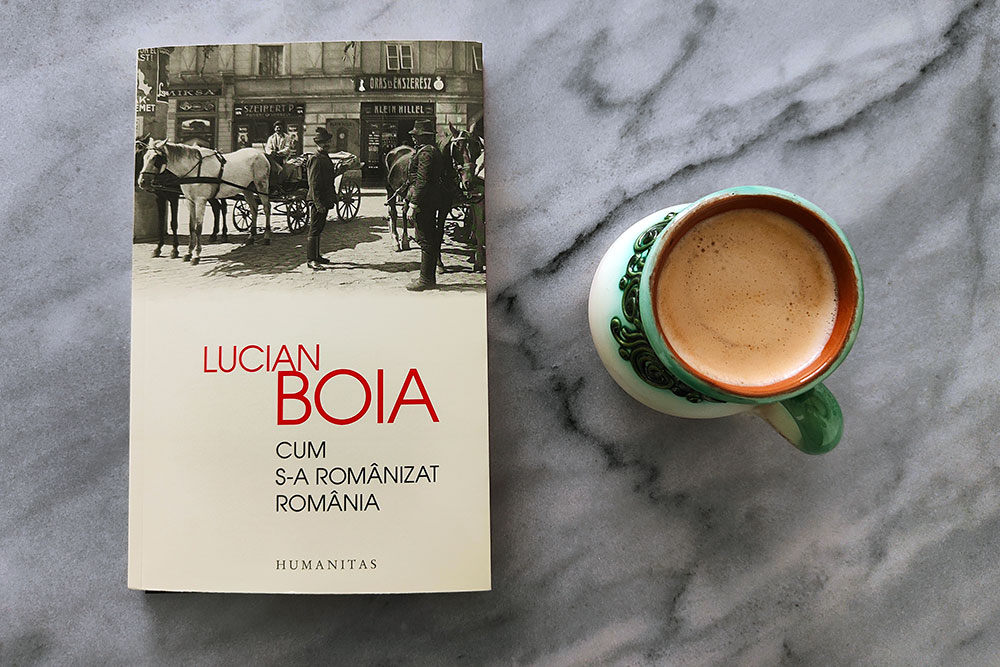
For those who read in Romanian, this is a must-read book. I think this might be interesting, if translated into English, for those who are curious about national sentiment, especially for a country as diverse as Romania and, of course, with a history that is so tumultuous.
Boia is a renowned Romanian historian and this book is based on a lot of statistics, how people saw their ethnicity and how it changed to being recorded as a language in the communist period. Romania had a president from a minority, German, and that is talked about at the end of the book. I agree with his assessment that only a German could have become president in Romania as not a lot of Romanians would vote for another ethnicity, such as Magyar.
I found it fascinating and I highly recommend it. I will include the blurb, translated:
“Each people has its own experience with ‘others’. Few, however, to such an extent and with such intensity as the Romanians. Situated in an ‘open’ and for a long time loosely structured region, the current Romanian space has known a diversity of political dominations and ethnic and cultural infusions.” In the Old Kingdom before 1918, the population of the cities was as mixed as possible in terms of ethnicity and culture. In the interwar period, Greater Romania included, alongside the majority Romanians, a diversity of nationalities like nowhere else in Europe. Lucian Boia shows how, starting with the Second World War, then during the communist period and in the years that followed, this diversity almost completely disappeared. Romania is more Romanian today than ever. Unfortunately, the author shows, Romanians also became “Romanianized”, breaking to a large extent, through the isolationism practised by the communist regime, from the values of Western culture on which modern Romania was built.
Cum s-a românizat România by Lucian Boia
Details about the picture: the mug is from Romania
My rating: 5/5 Stars
Would I recommend it: yes
Published by: Editura Humanitas
Year it was published: 2015
Format: Paperback
Genre(s): History
Pages: 142
About the author: Lucian Boia is a Romanian historian, known especially for his works debunking Romanian nationalism and Communism. Born in Bucharest on 1 February 1944, Boia is a professor at the Faculty of History of the University of Bucharest. His extensive and varied work includes numerous titles published in Romania and France, as well as translations into English, German and other languages. Particularly concerned with the history of ideas and the imaginary, he distinguished himself both through theoretical works on history (Playing with the Past. History between Truth and Fiction) and the imaginary (For a History of the Imaginary), and through his consistent investigation of a wide range of mythologies (from extraterrestrial life and the end of the world to communism, nationalism and democracy). He also brought new interpretations to the history of the West, France and Germany. In 1997, his work History and Myth in Romanian Consciousness caused a sensation and has remained a landmark in the redefinition of national history ever since.
Website & Social Media Links: –
I was watching a cooking competition show I enjoy on Food Network this week and one of the competitors had come to the US from Transylvania, Romania a couple of years ago. I thought it was interesting that the several times she mentioned it she never just said Romania. The episode featured cooking influencers from social media.
Kelly recently posted…Ponderings #39
Maybe she was from a minority, hence mentioning the region, or maybe she felt it sounded better, who knows. It is an interesting detail though. I rarely mention the region where I’m from and even if I do, when asked, almost nobody knows where is that. 😀