
Blood of Others by Rory Finnin
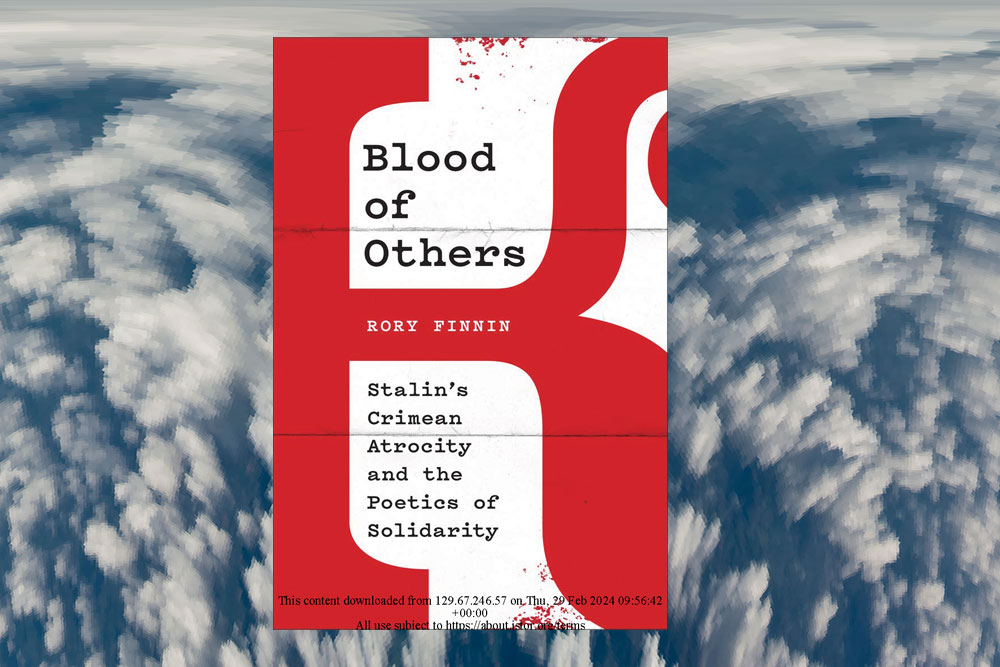
Blood of Others by Rory Finnin – Stalin’s Crimean Atrocity and the Poetics of Solidarity – is a book I wanted to read because I saw Finnin at a few events and he is such a great professor. At one of the talks he described some of the things covered in this book.
In 1944 Stalin ordered the deportation of ALL Crimean Tatars, a small Sunni Muslim nation, from their ancestral homeland. Tens of thousands died on the way to Siberia. It was not talked about, despite many russians and Ukrainians moving into the now empty homes of the deported Tatars. In soviet Ukraine and in Turkey only one thing kept this history alive – literature, both prose and poetry. Some of it was underground, some was published.
This book is a blend of history and literature and how narratives changed over the last two+ centuries in regards to Crimea, from 1783 onwards. It includes snippets of poems and it is a fascinating approach to the history of the Crimean Tatars. I would say that it sounds like a rather niche book, for an academic audience, unless someone is passionate about literature. I think many more would benefit from reading it though and the blend of history and literature makes it wonderful. I made a few notes from the book and I will share some points from it.
In 1905 a russian book by Gasprinsky described the Crimea Tatars as Turks, in an attempt to sever the bond between the Tatars and Crimea. This narrative was used in 2019 by the Turkish president Recep Tayyip Erdoğan, who cited Gasprinsky, to claim their interest in what is going on in the peninsula.
In the 1920s an attempt was made to return the Crimean Tatars back to Crimea, but Stalin opposed this.
A film, Alim, was banned in 1937, and most of the copies were destroyed. Even western scholars do not mention Alim as the first film made by Tasin, as it was so well expunged from history.
In 1944, Crimean Tatars were painted as heroes in Pravda and Izvestiia just hours before the deportations started. Many Tatars fought in WW2 and received medals for their bravery.
russian narratives that Crimea was ancient Russian territory by soviet propagandist-historians were used by Putin to justify the 2014 annexation.
Aleksei Adzhubei, Khrushchev’s son-in-law and journalist, travelled to Crimea in 1953 with Khrushchev. He said that Crimea was a desolate region. He said that transfer of Crimea in 1954 was a “business transaction”. Khrushchev was not pleased that the russian settlers demanded more money from russia.
After gaining independence, Kyiv was forced into giving up their nuclear arsenal otherwise there would have been no support from US (unlike russia, who received both financial support and the weapons and planes from Ukraine). Even so, Kyiv allocated around 140 million dollars for the resettlement of Crimean Tatars. Turkey pledged in 1994 to build 1000 new homes for the Tatars returning home. russia, who is responsible for the deportations and ethnic cleanings… paid nothing.
NashKrym is a book published in 2014, a compilation of 120 poets who “love” Crimea. The book is only in russian, all the poets are russian, there is no Crimean poet. Also, it translates as “our Crimea”. Basically it sounds like an ode to settler colonialism, russian-style, of 2014.
Blood of Others by Rory Finnin
Details about the picture: –
My rating: 5/5 Stars
Would I recommend it: yes
Published by: University of Toronto Press
Year it was published: 2024
Format: e-book
Genre(s): History
Pages: 352
About the author: Rory Finnin is Professor of Ukrainian Studies at the University of Cambridge. He launched Cambridge Ukrainian Studies in 2008. He is former Head of the Department of Slavonic Studies (2014-18) and former Chair of the Cambridge Committee for Russian and East European Studies (CamCREES) (2011-18).Finnin received his PhD (with distinction) in Slavic Languages and Comparative Literature from Columbia University. He also holds Certificates from the Harriman Institute and from the Institute for the Study of Human Rights at Columbia University. He is a Returned Peace Corps Volunteer (Ukraine 1995-97) and a native of Cleveland, Ohio.Since launching the Cambridge Ukrainian Studies program in 2008, Finnin has also curated and organised over 40 exhibitions and cultural events, from the Cambridge Festival of Contemporary Ukrainian Film to the Cambridge Vsesvit Literary Evening, which have enriched public understanding of Ukraine’s language, history, and society in Great Britain and beyond.
Website & Social Media Links: –
The mix of history and literature sounds like an interesting approach. I would say there were a lot of things that happened under Stalin that weren’t talked about!
Kelly recently posted…Poverty Point
That’s true. Stalin and the soviets were very keen on genocide, mass murder, and ethnic cleansing. From mid-1920s when he got power there were: the Holodomor (genocide of Ukrainians), the Purges (mass murder with a big of genocide of Ukrainians), started WW2, Katyn (mass murder of Polish officers), deportation of Crimean Tatars, famine (Ukraine and Moldova). Luckily he died a few years later. But all these events happened in Europe, who knows what happened in Asia, where most of russia is.
I wasn’t surprised by the attitude the russian have towards Crimea now, in 2014. Never learning from their past, they are still imperialistic and proud of it.