
A small town in Ukraine by Bernard Wasserstein
A small town in Ukraine by Bernard Wasserstein – Krakowiec and the storm of history – is the history of a small town, from its establishment in 1423 to 2022. Wasserstein’s family lived there and half of the book is about WWII and the Holocaust, but as seen in a small town and through a family history. It is a very good microhistory book and I do recommend it. I gave the book 5 stars, but with a caveat, I didn’t mark down the book for its epilogue, in which Wasserstein talks about Ukraine’s future and his views on Ukraine in May 2022.
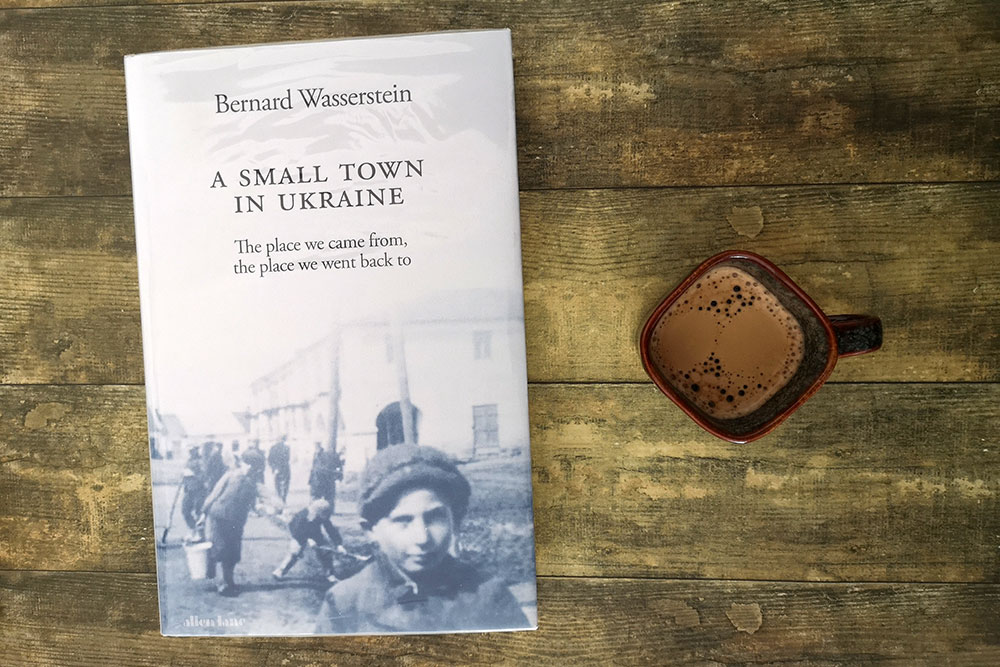
The town of Krakowiec is 40 miles west of Lviv, on the border with Poland. This means that in its history was part of Poland. His writing style is beautiful and perfect for non-historians who want to read something engaging and interesting, not dry. The first 100 pages are about pre-1900s period, covering things such as the palace of the Polish magnate Ignacy Cetner, he talks about the social history in a diverse place such as Krakowiec, where Poles, Ukrainians, and Jews called it home.
1914 was a watershed moment in the town’s history and the pogroms are talked. In the 20th century the story of the town is closely related to the story of his family. There are small things that I enjoyed reading about, such as languages spoken, between parents, between parents and children, why they chose at a particular time a language. The book also shows Polish and Ukrainian antagonism as he calls it. With a history of Polish nobles and Ukrainian peasants and a history of Ukrainian nationals killing Poles in their quest for an independent state, it’s clear that there were a lot of issues.
I also liked how he talks about national identity and acceptance of problems, he raised some interesting questions. Now, going to the caveat of the 5 stars, in the very short last chapter, the epilogue, he talks about Ukrainian nationalists being glorified. Somewhat naively he wrote ‘my view is that collective identities based on falsification of history are inherently contaminated and potentially dangerous”. Well, what is the true history? Focusing on the liberation aspect of the nationalism movement is akin to Americans focusing on other things when it comes to Thomas Jefferson and not his 600 slaves and children born to a slave. I would be more concerned with far-right in Germany and France where they have many places in parliament. I would be more concerned with the far-right in US where the moderate conservative voices are overtaken by MAGA. Ukraine was ok in 2022 when it came to far-right and it is ok now too.
Wasserstein also talks about how Ukraine is a corrupt country and, while they didn’t deserve to be invaded, there is the risk of them becoming too nationalistic. Hmm… maybe a bit like Israel and their elected (more than once) Netanyahu who was indicted for corruption in 2019? Israel is also a country which went through the Holocaust, but it failed to recognised the Holodomor as a genocide, even though Rapahel Lemkin described Holodomor as a clear example of genocide. Lemkin is the one who coined the term genocide after WWII, a term needed for prosecuting what happened in the Holocaust.
Wasserstein worked in Germany, US, and UK. So I assume, in talking about corruption he is aware of Gerhard Schröder’s corruption (with russian money), Donald Trumps’ corruption (with russian money), while London is referred as Londongrad (due to the amount of russian money). Ukraine has problems with corruption, of course. All countries do, but somehow this is visible only in the CEE countries and not the western ones by a vast majority of historians.
A small town in Ukraine by Bernard Wasserstein
Details about the picture: –
My rating: 5/5 Stars
Would I recommend it: yes
Published by: Allen Lane
Year it was published: 2023
Format: Hardcover
Genre(s): History
Pages: 320
About the author: Bernard Wasserstein is Allianz Visiting Professor of Modern Jewish History at the Ludwig Maximilians Universität, Munich. He previously held positions at the University of Chicago, the University of Glasgow, Brandeis University, Oxford University, and the University of Sheffield. He is a Corresponding Fellow of the British Academy.
Website & Social Media Links: –
Given your caveat about the epilogue., I’m surprised you didn’t mark it down for that. It sounds interesting, but I need a break from holocaust material. (and of course I, in my privileged life, feel a bit guilty for even saying that)
Kelly recently posted…The House on the Strand by Daphne du Maurier
I didn’t mark it down because the epilogue was short and not relevant to the history of the town, which is really good. I am sort of expecting western commentators/authors. It is annoying and I’m calling it out, but because it was so little of it, I didn’t mark it down.
It’s natural to take breaks from heavy topics. If you feel like reading about this again, I would highly recommend this book. It reads like a fiction book and the town is fascinating. It’s a bit too far from Lviv without a car (2-3h one way with the bus, only a bit over an hour by car), or I would have visited it.