
A History of the Medicines We Take by Anthony Armstrong, Anthony Cartwright
A History of the Medicines We Take by Anthony Armstrong, Anthony Cartwright* – From Ancient Times to Present Day – was great! I liked very much how the book started (cats and catnip) and how it was structured too. The first part of the book deals with the development of the drugs in early medicine to the drugs we use today, mostly synthetic chemicals. The second part of the book deals with dosage forms, from pills to inhalations, enemas to pessaries and suppositories.
The book assumes some basic knowledge, as, for example, at page 104 the authors write: “The gold standard for evaluation of any drug is a randomised, placebo-controlled clinical trial in a large number of patients”. For me the details were enough, as I am familiar with experiments (as they are called in psychology) using two or more groups. Also, if someone is not familiar with some of these concepts, it can be a great opportunity to learn something new.
A few pages later, at 112, I was surprised to read: “William Murrell (1853-1912) was a London physician… began treating angina patients with nitroglycerine in 1878. He published his findings on his trial in 35 patients (12 males and 23 females), in an article in the Lancet.” I had no idea nitroglycerine is so old. It is still used today for people who suffer of heart conditions such as angina. That was fascinating. Furthermore, I was also pleasantly surprised to read that in his trial both men and women took part. In today’s trials, as Perez remarked in Invisible Women, new drugs are not regularly tested in women (nor female rats) as hormones might influence the outcome of the study (which is rather pertinent as an information for 50% of the population). I would have imagined trials today are more forward looking than ones made in the 19th century and I would have been wrong, at least in this occasion.
This kind of details are mentioned in all chapters. The book offers so many details it was, at times, hard to remember all of them. This just means that I will skim read some chapters in the future, especially when I am going to study a specific time period. My favourite chapter was on inhalers, which is something I wouldn’t have guessed before. There I read about things like asthma cigarettes, these too are dating from the 19th century.
A History of the Medicines We Take by Anthony Armstrong, Anthony Cartwright
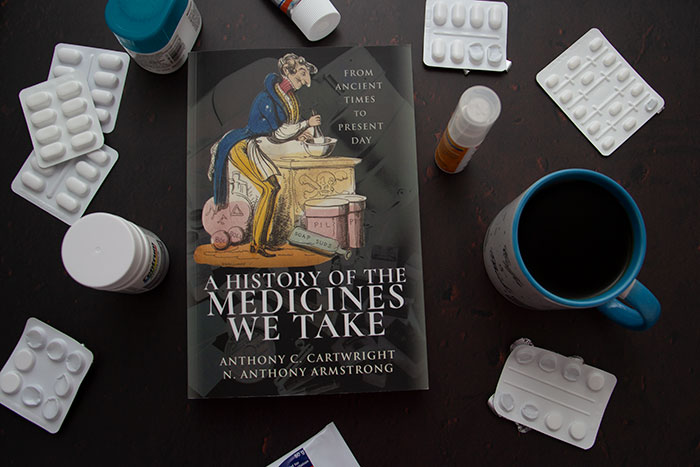
Details about the picture: lots and lots of medicines, of course
My rating: 5/5 Stars
Would I recommend it: yes
Published by: Pen & Sword History
Year it was published: 2020
Format: Hardcover
Genre(s): Broad subjects
Pages: 336
About the author: Norman Anthony Armstrong is a retired pharmacist who obtained his PhD at London University. After working in the pharmaceutical industry, he joined the Welsh School of Pharmacy, Cardiff University. He retired from there as senior lecturer in pharmaceutical technology. He is a Fellow of the Royal Pharmaceutical Society, and the author of over 170 scientific papers, reviews and books. He lives in Hertfordshire with his wife.
Anthony C. Cartwright is a retired pharmacist, who worked in the pharmaceutical industry, for the UK Medicines Agency, for a contract research company and in his own consultancy. He has written many reviews and research articles, written and co-edited three books on medicines regulation and contributed to four others. He is a Fellow of the Royal Pharmaceutical Society. He now writes on the history of medicine and pharmacy. He lives in Surrey with his wife.
Website & Social Media Links: Pen and Sword
*I was sent a copy of A History of the Medicines We Take by Anthony Armstrong, Anthony Cartwright for the purpose of this review. All opinions are my own.
I’ve added this to my list, I love reading about medicines. Especially medicines over the years or herbalism and apothecary.
Sam recently posted…The Original Rider Waite Tarot Review – A Review Of The Most Famous Tarot Deck
As you might guess based on things I’ve read in the past, this sounds really good to me!! I’ll have to see what my options are for reading it.
That’s a concerning statement about drugs not being tested on women in modern day trials. As you point out, that’s roughly 50% of the population. It’s only been in recent years that medicine has recognized how often diseases and conditions present differently in men vs. women. (thinking of heart attacks, in particular)
Kelly recently posted…Lawn Mower Race
You are right about heart conditions and sex differences. For example, aspirin reacts differently in women and men, which is such a wide spread medicine that most of us use regularly.
Mmm! Not a book that would call to me from the shelves, it might be a bit too specialised for me and a bit of waste for the few snippets of information I would find fun or useful. I did enjoy reading the extracts and facts you shared though, especially about the nitroglycerin, which like yourself, I had no idea has been in use for so long. My father used to take it regularly for his heart condition. I had to laugh at the notion that people were given ‘asthma cigarettes’ as a remedy for the disease, when the asthma society today spend all their time telling people that smoking can be one of the main triggers for the disease .A bit worrying that an asthma cigarette contained belladonna and stramonium though! Thanks for sharing and I hope that you have a good weekend 🙂
There are lots of interesting facts, like the ones mentioned in the review, but it is quite specialized indeed. I loved it though. 🙂